Google Reviews: how to ask for them (and how to reply without sounding desperate)
Reviews are the strongest signal in local SEO. How to ask for them, how to reply to positive and negative ones, and what Google actually forbids that almost nobody knows.

Laura Sande
Software developer and UX designer
7 min read
In this article
There’s one local SEO factor almost no one works on properly, and it carries more weight than almost any other: Google reviews. A business with 20 reviews averaging 4.5 stars will rank above one with zero, even if the latter has a better website, faster load times, and better technical SEO.
The curious part: asking for reviews is within reach of any business, costs nothing, and most do it poorly or not at all.
Why reviews matter so much
Google has said many times that reviews are a ranking factor in the local pack (those three map-based listings that appear when you search for “dentist” or “restaurant near me”). It’s not theory: if two businesses are the same distance away, have equally complete profiles and similar categories, the one with more and better reviews ranks higher.
The numbers from BrightLocal’s Local Consumer Review Survey 2024 frame what’s at stake:
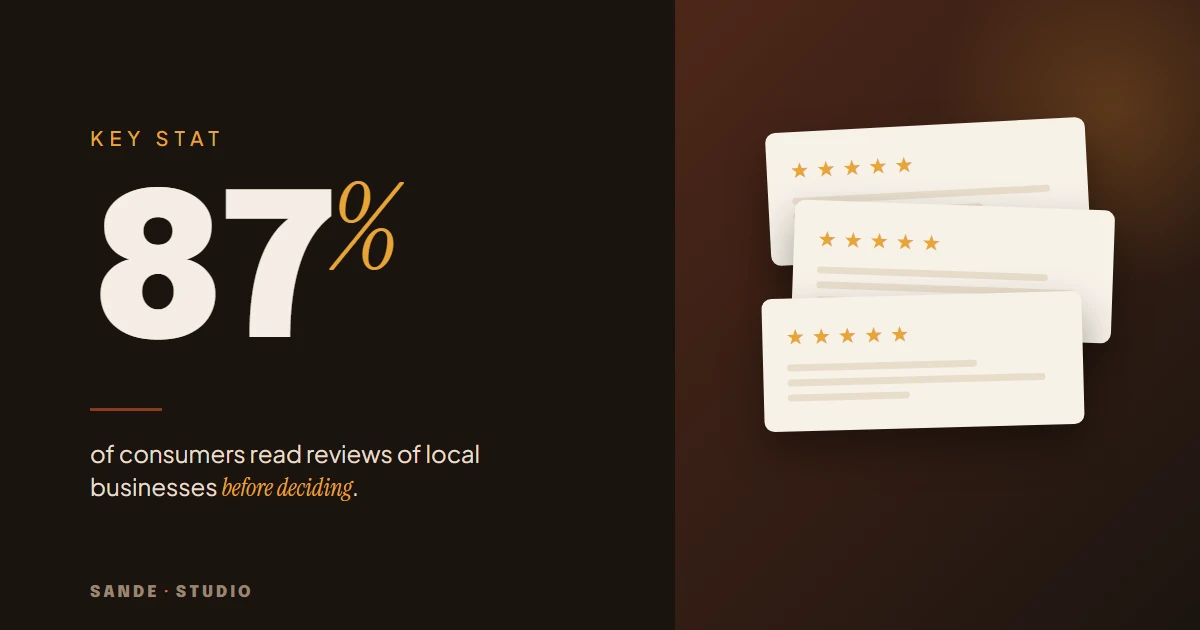
- 87% of consumers read reviews of local businesses before deciding.
- 73% only trust reviews written in the last 3 months. Old reviews count for little.
- The average person reads 7 reviews before deciding. Having one or two isn’t enough.
Translated: it’s not just how many you have. It’s whether there are recent ones, whether you respond, and whether there’s meaningful volume.
When to ask for the review (and when not to)
Timing is everything. Asking too soon or too late doesn’t work.
Good moments:
- Right after completing the service, when the customer has shown they’re happy.
- When handing over the product, if it’s a one-off sale.
- A few days later, if the service is experienced over time (a renovation, a treatment, a course).
Bad moments:
- In the middle of the service.
- When the customer arrives with a complaint or in a hurry.
- Right after solving a problem (the customer still associates you with friction).
Practical rule: ask when the customer has said something positive unprompted. If they’ve just told you “this was great”, that’s your moment.
How to ask without sounding desperate
The most common mistake is a sign at the till that says “Leave us a review!” with a tiny QR code. It barely works. People don’t pull out their phone, don’t scan, don’t write.
What does work:
Ask face to face. A short, sincere sentence that explains why. “If you enjoyed it, a Google review helps us a lot so more people like you can find us. I’ll send you the link right now.” The key is making it feel like a favour between people, not a form.
Send a direct link. Don’t say “find us on Google and leave a review”. That’s three steps. Send the short link that goes straight to the review form, already open. You generate it from your Google Business Profile dashboard: Customers → Reviews → Get more reviews. It gives you a g.page/r/... link you can share via WhatsApp or email.
Big QR code, in the right spot. If the customer is seated (a restaurant, a hair salon, a waiting room), a visible QR with a short sentence works. At the till, with someone standing and ready to leave, no.
Email or WhatsApp 2-3 days later. For services where the full experience unfolds over time (a move, a renovation, a web design). A short, personal message, without the obvious template feel.
Templates that work
Via WhatsApp, service just completed:
Hi [Name], I hope you’re enjoying [the result/the service]. If you have a moment and feel like it, could you leave us a Google review? Here’s the direct link: [URL]. It helps us a lot. Thanks so much!
Via email, after delivery:
Hi [Name],
It’s been a week since we finished [project/service] and I wanted to make sure everything is going as expected.
If it was a good experience, it would really help us if you left a Google review. It takes a minute and for us it matters more than any ad: [direct URL].
Thanks for trusting us.
Notice that neither case involves exaggeration, excessive emojis, or pleading. They ask the way you’d ask someone a favour, knowing they’re free to say no.
How to respond to positive reviews
Many people ignore positive reviews. Mistake. Responding has two effects: it shows future readers that you care about what your customers say, and it sends Google the signal of an active profile.
Basic rules:
- Respond to all of them. Yes, the 5-star ones too.
- Don’t copy-paste the same reply. Google detects templated responses and penalises you.
- Personalise at least one sentence. Mention something specific the customer said.
- Thank you + reinforce the positive point + invite them back. In that order.
Example:
Review: “Excellent service. Delivered on time and the finish is flawless. 100% recommend.”
Response: “Thank you, [Name]. We’re really glad the result was what you hoped for. That kind of finish takes time and care, and seeing it together at the end is the best part. Anything you need, we’re here.”
The important part: don’t sound like a robot. If I had only read your response, I should be able to picture the person who wrote it.
How to respond to negative reviews
This is where a business that knows how to communicate stands out. A well-handled negative review can convince a future customer more than ten positive ones.
The 4-step method:
- Don’t reply hot-headed. Breathe. Wait a few hours minimum. If you reply angry, everyone reads it.
- Thank them for the feedback and apologise if warranted. Even if you think the customer is wrong, thank them for saying it. “Thanks for telling us, we’re very sorry the experience wasn’t what you expected.”
- Explain what happened without blaming the customer. If there’s context (a busy day, an order mix-up, a one-off issue), share it without over-justifying. If the customer misunderstood something, correct calmly.
- Offer to continue the conversation privately. “We’d love to understand your case better. Can you write to [email] or call [phone]?” That shows there’s a human willing to resolve it and moves the conversation out of the public window.
What you should NEVER do: argue, call the customer a liar, be sarcastic, say “you’ve never been to our place”. Even if true, anyone reading later sees a defensive business.
Fake or unfair reviews: what to do
Sooner or later one appears. A competitor, a troll, a customer who confused you with another business. You have options.
Option 1: respond publicly. If the review is clearly unfair or false, reply calmly making clear why. Future readers will judge your response, not the review.
Option 2: report it to Google. From the review, click the three dots → “Flag as inappropriate”. Google takes anywhere from a few days to several weeks to review. Google’s content policy allows removal of reviews that are spam, fake content, conflicts of interest, offensive language, or don’t describe a real experience.
Don’t: insult, threaten legal action publicly, or contact the customer through other channels unless asked. All of that backfires.
The blacklist of what Google forbids
There are practices that seem like good ideas and are actually ticking time bombs. Google detects them and can suspend your profile:
- Buying reviews. There are services offering “50 5-star reviews for €X”. Google detects it via patterns (IPs, fake names, non-human behaviour) and removes them, downgrades your ranking, or suspends you.
- Only asking happy customers. Yes, it sounds logical. But Google’s policy forbids review gating: filtering so only happy customers leave reviews and redirecting unhappy ones elsewhere.
- Asking your employees or family for reviews. Google flags this as conflict of interest.
- Incentivising reviews with discounts or gifts. “Leave us a review and we’ll give you a free coffee”. Forbidden.
- Replying to your own reviews with other accounts pretending to be customers.
The only sustainable path is asking well, from real customers, without filters.
How many reviews you need before it shows
There’s no magic number, but there are useful milestones:
- Fewer than 5 reviews: invisible. Google barely uses you in the local pack.
- 10-15 reviews: you start competing in your area.
- 30+ reviews with 4.5+ rating: you enter the range where people decide to trust you at first glance.
- 100+ reviews: perceived authority. The customer assumes that if so many have been and rated, it must work.
What matters isn’t reaching those numbers in a month. It’s building flow: 2-3 new reviews per month for a year means 30 fresh reviews, which are worth more than 100 reviews from 4 years ago.
If you already have a running business, you probably don’t lack work — you lack Google knowing you exist. Reviews are the most direct way to tell them. They cost nothing, require no technology, and their effect compounds month after month.
Reviews are one more piece of local SEO in the Canary Islands. Want us to take a look at your Google profile and see what’s missing? Tell us about your case and we’ll give you a no-obligation review.
Keep reading
-
 Google Business Profile Local SEO
Google Business Profile: what your business needs to show up on the map
How to get the most out of your Google Business Profile. Practical guide for local businesses that want to appear in nearby searches.
-
 Technical SEO Local SEO
What Google sees that you don't when it visits your website
Two websites can look identical from the outside and be completely different underneath. Google doesn't see your site the way you do: it reads a layer you never look at, and that's where much of whether you show up gets decided.
-
 Web design Local business
Agency, freelancer or studio: who should build your website?
For the same "build me a website" you'll be quoted anything from 300 € to 6,000 €. The difference is rarely the design, it's who does the work. Here are the three models and when each one fits.
Need help with your website?
Tell us about your project and let's figure it out together
If you have questions about what you've read or want us to apply this to your business, get in touch.
Let's talk →